For the last couple of months I’ve been nattering on about discovering my dharma and the coincidences surrounding my departure from Royal Roads University. Somehow my acceptance that writing is what I truly want to do with my life, and the space created for writing by my untimely exodus from my post as a fundraiser for the Bateman Centre, seemed incomplete. There had to be a third coincidence.
My hope was that a meeting with a prominent Canadian literary agent in Toronto in August would round out the trio, land me a fat writing contract, and set me on a course for literary stardom, or at least literary self-sufficiency.
It was not to be. All the positive visualization, wishful thinking, creative manifestation, meditation and voodoo doll arranging in the world is no competition for a supportive, yet skeptical, battle hardened agent.
God answers all prayers, say some: sometimes he just says no. Or, as the Buddha and Lao Tzu said: all anticipation leads to disappointment. Instead I had to remain open to other signs. Of course, one presented itself.
One of the first things Jenn and I decided to do when I lost my job was to take a vacation. Liberated from the tyranny of three weeks of holidays each year, we were free to travel, so we headed for the American Southwest. We have both ventured there on numerous occasions, through never together. We planned to spend time riding our bikes and hiking near Moab, venture down the Colorado River and day trip into the Maze in Canyonlands National Park, camp on the North Rim of the Grand Canyon and take a quick tour through the Escalante.
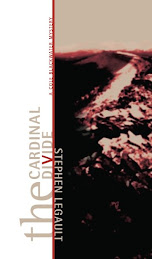
The protagonist in my books The Cardinal Divide, and the forthcoming Darkening Archipelago was inspired by the canyon’s of Utah. In the mid and late nineteen nineties I spent a lot of time kicking around Canyonlands National Park, doing two and three week long trips down the Green River, through the San Rafael Desert, and into Labyrinth and Stillwater Canyons. I employed a local outfitter from Moab called Tex’s Riverways, and became friends with the three brothers who ran the show, Tex having long since retired. Dirk, Devon and Darren were the kind of iconoclastic, offbeat characters that make a bone chilling jet boat trip up the Colorado River a great experience, and I’ve stayed in touch with them all these years.
I think it was on my second Green River adventure that one of the boys started referring to me as Glint Longshadow. As I noted in the back-of-the-book material for The Cardinal Divide, I think they had this image of me striding across the agoraphobic Utah desert, fighting evil developers with a iridescent glint in my eye. It’s hard not to become attached to such an image of oneself, and so when I was hunting around for a name for my first environmental murder mysteries’ leading man, Glint Longshadow came to mind. But that’s a ridiculous name (maybe they were making fun of me…) so I let my mind wander, and Cole Blackwater (some cadence, same number of syllables) emerged.
About a week before Jenn and I left for Utah I was stirring from my morning meditation when an idea surfaced from my cerebral morass: why aren’t I writing an environmental murder mystery series set in the Southwest?
Shortly the second book in the Cole Blackwater series will go to press. This series is set mostly in Canada. Canada is a very small country. It doesn’t publish many books. And it doesn’t really celebrate genre fiction. In fact, if most often looks down its nose at the field. Canadian Literature recently referred to my first novel as pulp fiction, through (bless their souls) they did recommend it.
But the United States, on the other hand…big country, lots of books and book publishers, lots of readers of crime and other genres. I love the Southwest, and have always wanted to write about it. Tony Hillerman, whose Jim Chee and Joe Leaphorn Navaho Tribal Police series first inspired my interest in the genre, passed away in 2008 at the age of 83, leaving a tremendous, if not unfillable, gap in the Southwest’s literary landscape.
So I set my intent to have a fully formulated idea for a mystery series set in Utah and Arizona by the time Jenn and I returned from our trip.
Intent is an incredible thing. I recall once staying at a century old hotel built over a hot springs near Helena, Montana and being fascinated with the place. It was in some disrepair; part of the hotel served as a retreat centre for Alcoholics Anonymous (I learned this when I cracked open a beer in the lounge). I went to bed that night with the intent of waking with a fictional story in my head about this hotel and its guests, and woke with a complete story-outline in my mind.
That was more than a decade ago. I’ve had a lot of practice over the last ten or more years at creating something from nothing. I have come to believe that like everything else, stories are merely a product of the energy and information swirling around the universe, born of an exploding star some ten billion years ago. We human’s, with our thick craniums and hyper-developed gift of imagination, are wired to be walking, talking receptors for these stories, and we quickly fashion them into tales about our own miraculous journey through life.
I love the creative process. I love taking an idea from inspiration through to cultivation. At first there is next to nothing. A single idea: in this case, a terrible, marvelous, beautiful landscape. What do I want to say about such a place? My own niche in the mystery genre is to tell stories that focus on environmental issues. It’s what I know the best. There’s no shortage of environmental calamities in the Southwest. How to choose? And how do I create characters and a plot that allows the reader to enjoy a good (maybe great) story without pummeling them over the head with an environmental message (that niche is already filled to overflowing). Who’s the protagonist? What makes him or her interesting? Why would a reader want to follow this person for three books (I think in trilogies best)?
All of these questions sloshed around in my head as I was preparing for and departing towards our Utah adventure. Jenn and I talked a lot about the ideas as they began to emerge – like startled, blinking voles from dark fissures in the earth – over the first week of the trip. At first, I didn’t want to talk about the ideas too much; I feared that if I let them out on their own, they would just slip away. But soon we were yakking for hours -- on our hikes in The Maze, over cold beer on the beach at Spanish Bottom, over grilled cheese sandwiches at a riverside café in Mexican Hat -- about the narrative arc of the trilogy.
Two and a half weeks into the creative process, I was ready to write it all down. We camped on the North Rim of Grand Canyon for three nights, and choose to forgo long hikes or mountain bike rides for more sedate explorations so I could have the afternoons to sit and scribble. At Point Imperial, with the wind howling and leaves blowing and sun setting, and again on the trail to Widforss Point, in a grove of golden trembling aspens, I sat and wrote and thought and wrote some more, all the while bouncing ideas off Jenn for perspective.
 (Sunset at Cape Royal on the North Rim of the Grand Canyon above, and below Sunburst through aspens on the Widforss Trail)

When we returned home a week ago I had two dozen pages of notes, including a stretch of how the three novels will work together, and biographical outlines of all the major characters. I’ve spent a few hours each day over the last week writing as succinct an outline as I am able for the trilogy, and hope to be able to start pitching it to publishers by the end of October.
I have no way of knowing now if the ideas I blurted out in the searing heat of the Maze, or jotted onto paper in the crisp autumn afternoons on the North Rim will emerge into the literary canon of the American Southwest. If they do, I have no way to say if anybody will read the books and enjoy them, discuss them with friends, seek out the awe inspiring landscapes I hope to populate with my characters, and maybe one day stand in a place where the protagonist stood in my imagination and have fiction and fact blur, if only for a moment. I have no way of knowing.
What I can say with absolute certainty is this: in just a few short weeks I was able to recognize and harness the power of events emerging and converging to produce ideas I find exciting and inspiring. If this isn’t what I’m supposed to be doing as part of a right-livelihood on this amazing planet, I don’t know what is.