It occurred to me for the first time the other day that I am already home. For more than twenty years I’ve believed that someday I would reach the apex of the spiritual journey – Nirvana, enlightenment – and that I would find myself…well, somewhere, free from worldly suffering. I would arrive at the journey’s end, like a road weary traveler, grateful to be finally home.
Sitting on a rock at sunrise, looking over the tapestry of tea plantations of Munar in southern India, reminded me that I’ve never been seeking enlightenment through all my running and my stillness.
If pressed I would say that what I am seeking is peace.
Just peace; a quiet heart; a moment of freedom from tiresome striving. Freedom from striving for wealth, striving for recognition, striving for health, striving to be loved, striving for wellbeing, for security. From illusion. Freedom from the promise of enlightenment.
And even freedom from striving for peace.
At times throughout my life I’ve worked very hard to find peace. The obstacles have been almost entirely of my creation, but they have proven to be formidable barriers. At times the passage has been arduous, leaving me disenchanted. If only I knew that I could simply end the search and return to the start. If only I could remember that at those times of disquiet I was as close to peace as I had ever been, then I might have simply sat down on the path and realized I was already home.
When we stop seeking enlightenment, when we cease the wearisome quest for peace, we see that it has been ours from the very start. From the moment of creation peace has been the gift from the creator: Tao, God, the quantum field.
We are already home.
I watch Rio and Silas asleep in their beds, arms splayed above their heads, their faces a perfect reflection of quiet serenity. There is no searching here; there is nothing to strive for.
“Seek nothing and find everything you need,” says the Tao te Ching. But we forget. We strive. We hope to wash ourselves clean of life’s anguish through meditation, prayer, stretching before exercise, Brussels sprouts and herbal tea. And it helps. But all striving is a form of suffering, including striving for an end to suffering.
So we return to a clear moment of peace and remember that we have always been enlightened. We have always been pure peace. We are born Buddha and remain Buddha throughout every moment of our life. We’ve just forgotten.
Maybe enlightenment then isn’t so crazy a notion then, if only I can keep myself from seeking it, and simply experience it, and then let it go.
Father Thomas Keating, of the Christian contemplative movement, says in the movie One: “In the beginning the spiritual journey is the realization, not just the information, but the real interior conviction that there is a higher power, or God. Or, to make it as easy as possible for everybody, that there is an Other. Second step, to try and become the Other. And finally, the realization that there is no Other. That you and Other are one. Always have been. Always will be. You just think that you aren’t.”
This doesn't mean that the journey is over. Far from it. Its just starting.
I had lunch with a friend in Toronto recently. He’s a literary agent. He’s one of the best in the business, and represents more than 350 of Canada’s brightest lights in literature, theatre, art and culture.I was there on other business, but we did have a few minutes to chat about my own writing career, and the news he delivered brought no cheer to my bookish heart.
According to my friend, book sales are down about 40% across Canada. This is part of a trend that pre-dates our current economic slump, and therefore will likely not respond when the economy starts its languid recovery.
It seems that I’m writing at the end of the age of books.
For those on tenterhooks for me to cut-to-the-chase (a rarity) here it is: I love writing books, and want to keep doing it. So how, in the age of Twitter and Facebook and Kindle and E-Readers, can an upstart like myself make money crafting stories more than 140 characters in length? Jump to the end of this posting to add your comments.
For the rest of you:
I’ve recently come to the conclusion that my Dharma – my purpose in life – is to write. I’ve been scribbling most of my life. When I was a teenager I used to slip out the back door in the middle of the night and perch under a street lamp and write the most ghastly, angst ridden poetry. I’ve penned stories for my collage newspaper and for The Globe and Mail; sold more than one hundred and fifty stories to dozens magazines and papers and had two books published; all the while trying to hold down other meaningful work to afford luxuries such as a mortgage, child support and premium beer.
So this news sucks. At least, it seems to.
And I’m trying to figure out what to do. I think a lot of writers are.
I’ve always said that the writing part of being a writer is easy. I’ve never had much trouble getting the words out. I’ve never experienced writers block. I have often suffered from a scarcity of time to write, and more often from a lack of focus or discipline, but my challenge hasn’t been writing: my challenge has been to make a living writing. The last time I tried was in the mid nineteen nineties and it was slim pickings’ around the Legault household, let me tell you (domestic beer….).
Making a portion of my living as a writer is important to me. It’s a symbol that my writing has value to others; it’s a symbol that people are reading my writing and that they are willing to support my writing with their hard earned pay. Earning at least part of my income as a writer will allow me to keep writing for some time to come.
There’s a lot to be said for the notion that I should just keep writing regardless of who wants to pay for it. If it’s my purpose to write, then I should let nothing stop me. There’s also something to be said that the need to be read has a good deal to do with my ego. While both arguments are true, I’m exercising my basic human right to ignore them.
I’m not a big trend spotter. I still have a pair of “dad-jeans” in my closet. But here are the trends that I see in writing and publishing: first, books are being replaced by digital media. E-books are a part of that, but blogs, citizen journalism, and all manner of social networking sites are providing content where professional writers, journalists and novelists once plied their trade.
Secondly: online, content still seems to be king, but it seems to be getting shorter and shorter.
I recently signed up for Twitter, which until a couple of weeks ago I thought would make me look like a complete twit. I have a hard time taking anything on which one tweets very seriously. But there it is. I have three followers, and I’m pretty sure they are just a “pity” group; you know, the people who choose to follow me because I picked them as the people I wanted to follow.
One friend suggested that Twitter was like Facebook, but with less crap, and shorter postings. To me, Twitter seems like a microcosm of what is happening to content, and I’m trying to figure out how I can compress what I’m trying to say with my life into 140 character Tweets. (For example, last week I sent the manuscript for my next novel – The Darkening Archipelago – to my publisher. At 610, 654 characters (110,000 words) I would have to post 4,362 tweets to convey this books content to the Twitosphere. My three followers might protest. At least their dissent would be brief.)
Digital media contains much promise, and some considerable peril, for writers. I feel like a messenger without a medium.
The digital book market today is where the digital music market was five or ten years ago, but without the promise of Napter to force a solution, though Google might provide the necessary incentive for more publishers to recognize the trend. E-Readers like the Amazon Kindle and Sony Reader could be to books what the iPod was to music, but they have yet to catch the imagination and wallet of the general public. The promise is great: who didn’t want one of those crazy reading tablets that Captain Jean Luc Picard had on Star Trek the Next Generation? But Captain Picard didn’t have to tot his around in rainy Vancouver, or worry about running out of power in the middle of a plot twist. He didn’t read in the bathtub much, though that’s unsubstantiated.
And what will happen to Libraries and book stores if books vanish? Will the great books stores of my life go the way of Sam the Record Man?
Then there is the story of the Cushing Academy, a prep-school near Boston, Massachusetts, that is replacing its collection of 20,000 books with 18 Kindles, three giant flat screen computer monitors, and a coffee shop. The headmaster explains that he’s replacing the schools meager collection of books with millions becoming available online.
I just don’t know what to make of that.
My literary agent friend explained that I’m a writer between mediums. Books are dying and digital media has yet to catch hold. We’re struggling how to monetize this new format.
But monetize it we must. As a lifelong environmentalist, I know we can’t keep printing books on paper, even if it is ancient forest friendly. I can’t write environmental murder mysteries on an environment that has been murdered.
And monetize it we must: if anybody but the biggest names in literature are going to keep writing books, then we have to find a way to pay them. If we don’t, we’ll all just be blogging about what we did on the weekend with our kids.
I’ve always imagined myself to be a pretty modern person. A little stogy, but also on the cutting edge. Ok, maybe not. But I want to be. And it looks as if I will have to be, if I’m going to write books for a living. I just don’t know what my books will look like when I finally trick a big publisher into accepting my stories for print.
So I turn to you: tell me what you see as part of the trend in digital publishing: how are writers going to make a living? What is the future of books? What can we do to actually get out in front of this transformation of the written word?
The dictionary definition for coincidence is: “something that happens by chance in a surprising or remarkable way.”
I don’t believe that what we perceive as coincidence is mere chance, and I don’t think we should be surprised by their occurrence.
Case in point: a month ago I lost my part time job at Royal Roads University. As I mentioned in Part One of this treatise, accepting this change wasn’t hard. RRU provided good, meaningful work and with amazing people in service of a noble cause, but it wasn’t a good fit with my life’s other priorities. Hard times forced the University to make changes, and eliminating my position at the Foundation was one of many.
And I saw the change coming, though only at the last moment.
It was no coincidence that only a few weeks previous I’d written a piece called Conduit, in which I said “what I know for certain, however, is that by discovering my Dharma – or what will certainly be a part of my life’s purpose – I have been able to tap into an abundance I had never imaged existed before in the universe.”
Writing is my Dharma. Professionally speaking, it’s what I am on this earth to do. It is my purpose.
That is what Dharma is: it is our purpose in life.
That a piece of writing would emerge from me – after laying dormant for more than a year – just a few weeks before such an important change would occur, is not a coincidence. It’s a sign post.
I recall another such crossroads. In the late 1990’s I was kicking around Alberta’s Bow Valley, making a meagre living as a part time pain-in-the-ass environmental activist and communications consultant, and penningstories for just about anybody who would publish them.Being a freelance writer in Canada, and a chronically underemployed sorta-professional environmental advocate in Alberta, are two of the least lucrative means by which to earn a living. I figured by doing both I might double-down on a hardscrabble effort.
I remember saying on January 13th, 1999 – my 28th birthday – that something would have to change. At the end of every month I had nothing left, and most often paid the rent late thanks to less than punctual payment from my sole employer.
And then I got a call from someone who I went to high school with, and who I had run into at a conference in the fall of 1997, asking what I was doing for work. Within a few months I had a choice I had to make: full-time, gainful, and comparatively well paid employment with an international conservation organization, or to continue trying to scrape together a living as a writer and consultant.
Around the same time, I had a beer with an acquaintance, one of Canada’s truly successful freelance writers, Andrew Nikiforuk. I talked with Andrew about my paradox and he gave me a sage piece of advice: “You can’t make and report the news at the same time.”
I decided to make the news, and so I took a position with Washington, DC based Defenders of Wildlife, and helped them set up shop in Canada, which lead to the creation of Wildcanada.net, an online activism and grassroots mobilization effort I helped pilot for the next six years.
Writing was shuffled to the back burner. I remember that at the time I was penning a by-weekly column for my local newspaper, the Canmore Leader. My work with Wildcanada.net had me flying back and forth between Ottawa and Calgary, working on national parks and endangered species legislation, and later living in Vancouver organizing around the 2000 federal election. I started writing my stories about the Bow Valley from the airplane. I gave that up too.
I continued to write (mostly press releases and action alerts), but it wasn’t until my time with Wildcanada.net was coming to a close that I began to pursue publishing again.
It was the right decision at the time. It was no coincidence that my old school acquaintance called when he did.
Just as today – more than a decade later - it’s no coincidence that one of the barriers to writing has vanished.
Coincidences are an indication of the direction we are supposed to take in life. Put more forcefully, they are a sign from the Universe, from God, from the Tao – the universal energy from which all things emerge and exist -- of what we need to do to fulfil our Dharma.
When we want something in our lives, we radiate energy that attracts these things too us. All that exists in the universe is simply energy and information, which when organized a certain way can create matter. Our thoughts are energy and information too, as is the passion of our hearts. When we want something deeply, profoundly, our passion is expressed into the web of energy and information in a way that actually changes the fabric of the universe. The universe, the Tao, God, responds to our desire, to our incantation, to our prayer.
I don’t believe this happens in one trivial way portrayed in the movie The Secret. I don’t think we can sit down in a chair and wish for a fancy new car – going so far as to pretend to be enjoying the thrill of driving it – and low and behold, the car appears in our life, after an appropriate waiting period.
More likely is the story of Jake Canfield, author of the vastly popular Chicken Soup for the Soul books, and success coach, who after spending long years dreaming and striving for his own success, began to notice what some might construe as coincidences, but he rightly identified as signposts.
I do, however, believe that we can will these signposts into existence.
Where the movie The Secret explains just enough about the world of Quantum Physics and eastern philosophy to get people excited, it leaves out two critical components: First, just as luck favours the prepared, so does coincidence. Canfield noticed the signposts, was prepared, and followed them.
To be prepared means to be ready to serve. To be prepared means to know what we can do that creates a sense of bliss, and then dedicate ourselves to it. Some believe that success can only be achieved through hard work, and that to be prepared means to have toiled. I believe that many long hours must be logged in service of our Dharma, but the bliss we feel as a result of connecting with our life’s purpose erases much of the drudgery that may accompany the effort.
Secondly, discovering Dharma is a uniquely spiritual experience about our service to humanity, to the earth and its myriad creatures. For many it will be about our service to a higher power, be it God, Mohammad, Jesus Christ or the Tao. These are all just words for pure love.
If the energy we radiate is greed, or anger, or fear, then we might attract material objects into our lives for a short time, but over the long term, our purpose in life will remain unfulfilled. But if we are serving a higher purpose -- if we are serving love – then discovering our Dharma can become a fulcrum with which we leverage our broader spiritual awakening.
Love is the energy that binds the universe together, creates solar systems and single cell amoebas; when we serve with love we have a direct portal to the tapestry of creation.
Serving with love has been central to my discovery of my Dharma. It’s helped me to become prepared to follow the signposts when I see them. Fear and anger have acted like blinders to my ability to clearly see signposts in the past. That’s starting to change.
I don’t purport to have the answer to how we might all become better at creating the signposts, seeing them, and then following them. I can tell you how I have started: meditation.
(Note the emphasis on started…. That’s not a typo.)
Meditation quiets the mind. If our minds are busy, busy, always racing, then it’s hard to notice the often subtle indications of direction the Universe provides. Meditation is a deep breath in my day. It is a prolonged and refreshing pause.
Meditation also helps create clarity around what it is we really want. My process for creating clarity was to write down a page of things that we really important to me: to have my children in my life on a daily basis; to be a conduit for stories with meaning; to do important work helping people make the world a better place; to find a great love and hold that love close to me throughout my life. Before I meditate, I take a moment to recall these priorities, and then I surrender them to the universe, to the Tao, and let them go. Letting go of the outcome is central to this effort. If you have a preconceived notion of how the universe will respond, you’ll likely miss important markers along the journey. You’ll spoil the surprise.
Meditation is a means by which we can directly connect with the energy and information that is the foundation for everything in the universe. Everything that our hearts desire, including peace, love, joy, and all the trinkets that make day to day life interesting – are comprised of that energy and information. When we slip into the empty space between our thoughts, beyond the chatter, we are touching the textured fabric of existence. We can insert our longing there, we can leave behind our prayer, we can weave our supplication into that fabric, and we can colour it with our love.
And then let go.
Meditation and prayer -- stillness – is one means of preparation. It is the yin. The yang is action: in my case it’s more than twenty years of writing. It’s running. Its being a loving husband and father. It’s a lifetime of service. It’s what Stephen Covey calls “sharpening the saw:” building our skills, becoming proficient; being ready to act when the signposts appear.
Deepak Chopra says: “Discover your divinity, find your unique talent, serve humanity with it….You will begin to experience your life as a miraculous expression of divinity – not just occasionally, but all the time. And you will know true job and the true meaning of success – the ecstasy and exultation of our own spirit.”
And so, when my signpost appeared, in the form of a pink-slip, I was prepared to act.
It’s worth mentioning here that the path isn’t always straight. In fact, I doubt it ever is. It’s crooked, most often, and a little dangerous. You start inserting your desires into the fabric of the universe and every now and then you’re going to drop a thread. My experience is that the universe doesn’t just put up a neon sign that says “Hey Legault, this way to prosperity and success as a best selling author,” though if wishing made it so.
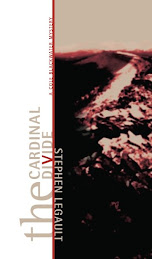
It’s a journey. And it’s not straight forward. A week after losing my position at RRU I had a call with a man who I had hoped would represent me as a literary agent. I thought that maybe his call was going to be the next signpost pointing to success. This prominent agent and I had become friends, and chatted nearly every week. He read my second book (The Cardinal Divide) and I had hoped that he would agree to representing me. He didn’t say no, but he didn’t agree to take me on as a client. And while that might yet happen, but it’s not turning out how I had envisioned.
No doubt his call was a signpost, but it wasn’t the one that says “this way to literary success!”
It told me I had to dive deeper into my writing; it told me I had to craft stories with more heart, more soul, more love.
And it reminded me that faith is crucial to Dharma. It’s about believing in you. When you discover your Dharma, when you are doing the blissful, but often arduous work to prepare yourself, when you are engaged in the passionate and perilous spiritual journey, you must have faith. You have to believe that you are worthy, and that you deserve to succeed.
I’m writing everyday now. I’ve got a dozen ideas for books in my head, on paper, and in progress. At the same time, I’m re-launching Highwater Mark Strategy and Communications, because serving people who are making the world a better place is an honourable and exciting way of earning a living. Double down again.
And I’m sitting still, trying by not trying to touch the fabric of the universe and insert a handful of little prayers into the vastness of the Tao.
I don’t know what is going to happen next but I believe that it will be extraordinary and I’ll be ready when it does.
Stephen Legault is a writer, activist, organizational development consultant and fundraiser who lives in Victoria, BC and Canmore, Alberta.
Stephen started writing in 1988. Kicked out of his high school biology class, he bought a notebook and sat down in the woods near his Burlington Ontario home and wrote some really awful, angst ridden poetry. Since then, Stephen has written for the Globe and Mail, Canadian Geographic, Outdoor Canada, Canadian Wildlife, and dozens of other periodicals and newspapers. His first book, Carry Tiger to Mountain: The Tao of Activism and Leadership was published in April of 2006 by Arsenal Pulp Press.
The Cardinal Divide is the first in a series of environmental murder mysteries featuring Cole Blackwater. It will be published by NeWest Press in November of 2008. The series will combine gritty, action-oriented stories and rich human drama with real environmental and social justice conflicts.
Stephen is a runner, photographer, and father of two beautiful boyz: Rio Bergen and Silas Morgen. He and his partner Jenn travel and explore the natural world of the Pacific Northwest and Rocky Mountains.