The Buddha that sits in my entrance way has a tiny Santa hat perched jauntily on his head; set at a rakish angle, it juxtaposes perfectly against Gautama Buddha’s serine expression.
I love Christmas. I inherited this from my mother, who worked slavishly to ensure that the season was a flawless expression of the image of her family she projected on the world. Our home was always perfect; presents were piled high under the tree which itself was cut on our property in Northern Ontario in an idealistic holiday gathering of caroling friends and merriment and dragged home through the waist deep snow, dinner was an elaborate affair that often induced early forays into eggnog and rum, hold the eggnog.
I love Christmas, but I’m not enamored with the wild debaucherous consumerism that seems to infect our society like some kind of pathological screwworm, always present but most veracious at this time of the year. But like all things in life, I live with the paradox that I enjoy giving gifts. So I go shopping.
This year I went in search also of the Buddha Claus.
While wandering the downtown streets of Victoria, or through the cities many shopping malls, I tried to imagine what it would be like for a four year old to sit on the Buddha Claus’ lap and read off their wish list. The Buddha would listen placidly and then, with a warm smile, would explain that much suffering is born from desire and the illusion that “things” can provide us with fulfillment and stave off the inevitable end of our impermanent nature of our transient existence. Then the children would be sent on their way, a copy of the Dhammapada clutched in their sticky fingers.
Maybe the Buddha Claus isn’t for everybody.
I spent my albeit brief time in long lines in retail outlets doing what I could to make the lives of those around a little better. I gave them the gift of a smile, a friendly word, a feeling of camaraderie, and the so necessary sense of human connection. I failed at this effort a few times, providing unwanted verbal assistance from the safety of my glass and steel bubble to those who failed to grasp that parking lots don’t mean that you simply stop unexpectedly and interminably in the middle of them.
But I hope that in the main I was able to relieve people of a little suffering during what is often a stressful and lonely time of the year. And in doing so, relieve myself of some suffering. It’s the illusion of our separateness that so often leaves me feeling unnerved.
As I’ve said before, the purpose in all my running and my stillness isn’t to achieve enlightenment – the permanent end of suffering – but to simply find some peace. Christ taught us that the meaning of Christmas is peace on earth. The Buddha teaches us that the purpose of life is peace in our troubled souls. We can’t have one without the other.
In the spring of 1996 I pushed off from the public boat ramp in the town of Green River, Utah, with two friends, three weeks of food, my two Nikon FM2 camera’s and 60 rolls of film. For the next 21 days we explored the length of Stillwater and Labyrinth Canyon’s; 120 river miles, and another hundred or more on foot up the Green River’s dendritic side canyons. I shot all my film, dropped one roll into the waterlogged bottom of our raft but managed to save it, and came out of the canyon country with a few dozen good shots and a hunger to shoot more.
(The Green River, from Green River Overlook, Canyonlands National Park, Utah)
It wasn’t my first trip to the Four Corners region. During the winter of 1993-94 I spent five months in the Southwest, first volunteering at Grand Canyon National Park as a Ranger Naturalist, and then down through southern Arizona and New Mexico, and back up through the high country around Santa Fe. But I was stupid, and was traveling light, so didn’t bring my real camera with me, just a tiny Olympus point-and-shoot.
Since my first trip down the Green River I’ve been back to Utah five times, including three other trips on that wonderful river, and a five-week-long exploration of the Grand Staircase-Escalante National Monument and Zion National Park in western Utah. At the end of September Jenn and I spent two weeks in southern Utah and Northern Arizona; it was a powerfully creative time.
Photography is the art of bending light. The eye beholds the scene, and the heart longs to capture the beauty before you. The mind calculates how. The camera is the tool through which light passes and is recorded, for the longest time with silver on the film plane, and now through ones and zeros on the memory card. The light must bend through eye and heart, through head and lens, through bits and bytes to emerge transformed by the creative process on the screen, on the wall, on the print before our eyes once again.
The American southwest is one of my hearts true homes. It’s a joy to share it with you.
(Above, Jenn in Dry Fork Canyon, and below, descending into Peekaboo Gulch, Grand-Staircase Escalante National Monument, Utah)
(Jenn's shot of me in Spooky Gulch, and my lay-down on your back shot of Dry Fork Canyon,
Grand-Staircase Escalante National Monument, Utah)
(It's a tight squeeze in Spooky Gulch, and it got even tighter. I set the ISO at 1600 so I could hand hold the camera in the low light of Spooky Gulch, above and below)
(Jenn in Dry Fork Canyon above, and below, moonrise and Balanced Rock, Arches National Park, Utah)
(Above, Canyonlands National Park looking towards the La Sal Mountains, and below, a storm trails over the The White Rim of Island in the Sky, Canyonlands National Park, Utah)
(Sunset from Cape Royal, North Rim, Grand Canyon National Park, Arizona)
(Standing Rock, above, near The Maze, Canyonlands National Park, and below, Jenn's shot of me in a cave formed from massive slabs of sandstone in the Doll's House region of Canyonlands.)
October 24th is the International Day of Climate Action; a mere six weeks before COP15, the United Nations Climate Change Conference to be held in Copenhagen December 7th through 18th. If we’ve been good and eaten our vegetables the world’s leaders just might approve a meaningful, binding and ambitious climate change treaty that restricts CO2 emissions to 350 parts per million. They currently stand at 390 ppm and are rising by 2ppm each year.
According to just about everybody who knows anything about this stuff, 350 ppm is the level beyond which life on earth becomes really uncomfortable, if not downright impossible. Some world leaders are toying with a ceiling of 450 ppms, which might be politically expedient, but only for those who like intolerable heat, continent wide droughts, killer floods, constant and colossal storms, the extinction of much of the planet’s wildlife, global pandemics and the whole-sale collapse of the planet’s life support systems.
For the record, I’m urging the adoption of 350.
(Hampi, in Karnatika, India, was the site of massive flooding recently that took many lives)
Today is Blog Action Day. It’s a little thing. There’s about 9,000 bloggers, in 149 countries around the world writing about climate change today. I’m doing my small part (for ideas on what you can do, go here).
It would be pretty easy for me to join them in the condemnation of global leaders for their failure to act on this most pressing issue facing humanity today. In particular, here in Canada, it would be easy to point to the spineless inaction of Stephen Harper’s conservative government as he positions us at the top of one list (highest green house gas emissions per capital – yes, we finally beat the Americans) and at the bottom of another (worst track record for action on climate change of all the G8 countries).
Easy, but redundant. Everybody else is writing that today.
For many years now, and with increasing intensity, I’ve been studying the teachings of Gotama Buddha. The looming catastrophe of climate change is enough to test anybodies spiritual resolve, as it has tested mine. I have found myself turning again and again to the wisdom of the Buddha for spiritual grounding during this progressively troubling period in human history.
A few things emerge from the Buddha’s teaching that have helped me, and might help others.
The underlying foundation of Buddhism is the Four Noble Truths. They are 1) that life has suffering, 2) that suffering has an origin, 3) that suffering can be ended; and 4) that there is a path to end suffering and it is called the Noble Eightfold Path.
Suffering is a product of attachment; attachment to possessions, to relationships, to situations, to our own ego. Buddhism teaches us to find sanctuary in uncertainly; to become comfortable in the fundamental uncertainly of our everyday existence. These are the most uncertain of times; not since World War Two has the world faced so perilous a threat to our survival. The consequences of our failure to curtail green house gas emissions could be dire indeed.
If we are to summon the courage and compassion to face this global threat, we’re going to need to be secure with insecurity.
Within the Noble Eightfold Path are a number of wise and practical lessons that humanity might consider as it struggles to address climate change. Listening to author and scientist Tim Flannery on the radio two days ago made me think about this. Flannery, whose book The Weather Makers was a game changer for many who were struggling with climate change, has a new book out called Now or Never. In the CBC radio interview he said that “we need to make that moral shift. [We need to make a] commitment to each other as human beings that we want to make a better world.”
The interviewer asked Flannery about his definition of sustainability, in the context of climate change: “It’s a simple aspiration,” he said. “I want to leave the world a better place than what I was born into. Is the lifestyle I’m leading and what I’m doing, really adding up to that, or is it leading to something different?”
What Flannery is talking about is the similar as the Buddhist principle of Right Livelihood. In the teachings of Vipassana Mediation, a 2,500 year old tradition passed down from the Buddha, Right Livelihood is understood to mean that “neither directly nor indirectly should our means of livelihood involve injury to other beings.”
Think about that. Imagine a world where we sought to make our living without doing harm, or causing harm to be done.
I believe that part of what is driving us so recklessly towards self destruction is our unwillingness to become comfortable with uncertainty, and our need to placate ourselves with distractions that fuel livelihoods that are cause great harm and suffering around the world. We are fundamentally afraid of the true nature of life – temporary, uncertain, difficult yet heart-breakingly beautiful – so that we suffer deeply. Our suffering causes us to seek placation: we buy bigger, faster cars; we gobble up foods that are unhealthy and that are grown unsustainably (Twinkies are not grown organically); we live in massive houses that isolate us from each other and require enormous amounts of energy to heat and illuminate. The list of what we use to temporarily insolate us from the true nature oflife is long and sad.
All of this distraction requires industries that cause deep, lasting harm in the form of ruined ecosystems and an atmosphere that has surpassed the safe level of CO2 emissions. We are killing life on this planet because we are afraid to face our own reality, and because there are those who are willing to reap profits from this preoccupation with comfort and false security.
There are many solutions to climate change, and it’s likely that 8,999 of my fellow 9,000 bloggers today will catalog them. Political action is most necessary, because trying to cajole behavioral change from a society that is so deeply invested in its own distractions will take far too long, with far too uncertain a prospect for success (and I’m just not comfortable with that). As the current thinking goes, we need a climate deal in Copenhagen that is ambitions, fair and binding.
But what we also need is a spiritual awakening. And whether we wake up to the Dharma path, to Tao Tzu’s teachings on the Way and its Power, to the sermons of Jesus Christ or Mohammad or any other of the worlds myriad interpretations of spirit, until we substitute genuine love, compassion, understanding and acceptance of our fragile, temporary and remarkable lives for the material distractions that blind us, we will continue to inflict immense harm on ourselves and the many creatures we share this fragile earth with.
For the last couple of months I’ve been nattering on about discovering my dharma and the coincidences surrounding my departure from Royal Roads University. Somehow my acceptance that writing is what I truly want to do with my life, and the space created for writing by my untimely exodus from my post as a fundraiser for the Bateman Centre, seemed incomplete. There had to be a third coincidence.
My hope was that a meeting with a prominent Canadian literary agent in Toronto in August would round out the trio, land me a fat writing contract, and set me on a course for literary stardom, or at least literary self-sufficiency.
It was not to be. All the positive visualization, wishful thinking, creative manifestation, meditation and voodoo doll arranging in the world is no competition for a supportive, yet skeptical, battle hardened agent.
God answers all prayers, say some: sometimes he just says no. Or, as the Buddha and Lao Tzu said: all anticipation leads to disappointment. Instead I had to remain open to other signs. Of course, one presented itself.
One of the first things Jenn and I decided to do when I lost my job was to take a vacation. Liberated from the tyranny of three weeks of holidays each year, we were free to travel, so we headed for the American Southwest. We have both ventured there on numerous occasions, through never together. We planned to spend time riding our bikes and hiking near Moab, venture down the Colorado River and day trip into the Maze in Canyonlands National Park, camp on the North Rim of the Grand Canyon and take a quick tour through the Escalante.
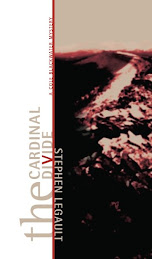
The protagonist in my books The Cardinal Divide, and the forthcoming Darkening Archipelago was inspired by the canyon’s of Utah. In the mid and late nineteen nineties I spent a lot of time kicking around Canyonlands National Park, doing two and three week long trips down the Green River, through the San Rafael Desert, and into Labyrinth and Stillwater Canyons. I employed a local outfitter from Moab called Tex’s Riverways, and became friends with the three brothers who ran the show, Tex having long since retired. Dirk, Devon and Darren were the kind of iconoclastic, offbeat characters that make a bone chilling jet boat trip up the Colorado River a great experience, and I’ve stayed in touch with them all these years.
I think it was on my second Green River adventure that one of the boys started referring to me as Glint Longshadow. As I noted in the back-of-the-book material for The Cardinal Divide, I think they had this image of me striding across the agoraphobic Utah desert, fighting evil developers with a iridescent glint in my eye. It’s hard not to become attached to such an image of oneself, and so when I was hunting around for a name for my first environmental murder mysteries’ leading man, Glint Longshadow came to mind. But that’s a ridiculous name (maybe they were making fun of me…) so I let my mind wander, and Cole Blackwater (some cadence, same number of syllables) emerged.
About a week before Jenn and I left for Utah I was stirring from my morning meditation when an idea surfaced from my cerebral morass: why aren’t I writing an environmental murder mystery series set in the Southwest?
Shortly the second book in the Cole Blackwater series will go to press. This series is set mostly in Canada. Canada is a very small country. It doesn’t publish many books. And it doesn’t really celebrate genre fiction. In fact, if most often looks down its nose at the field. Canadian Literature recently referred to my first novel as pulp fiction, through (bless their souls) they did recommend it.
But the United States, on the other hand…big country, lots of books and book publishers, lots of readers of crime and other genres. I love the Southwest, and have always wanted to write about it. Tony Hillerman, whose Jim Chee and Joe Leaphorn Navaho Tribal Police series first inspired my interest in the genre, passed away in 2008 at the age of 83, leaving a tremendous, if not unfillable, gap in the Southwest’s literary landscape.
So I set my intent to have a fully formulated idea for a mystery series set in Utah and Arizona by the time Jenn and I returned from our trip.
Intent is an incredible thing. I recall once staying at a century old hotel built over a hot springs near Helena, Montana and being fascinated with the place. It was in some disrepair; part of the hotel served as a retreat centre for Alcoholics Anonymous (I learned this when I cracked open a beer in the lounge). I went to bed that night with the intent of waking with a fictional story in my head about this hotel and its guests, and woke with a complete story-outline in my mind.
That was more than a decade ago. I’ve had a lot of practice over the last ten or more years at creating something from nothing. I have come to believe that like everything else, stories are merely a product of the energy and information swirling around the universe, born of an exploding star some ten billion years ago. We human’s, with our thick craniums and hyper-developed gift of imagination, are wired to be walking, talking receptors for these stories, and we quickly fashion them into tales about our own miraculous journey through life.
I love the creative process. I love taking an idea from inspiration through to cultivation. At first there is next to nothing. A single idea: in this case, a terrible, marvelous, beautiful landscape. What do I want to say about such a place? My own niche in the mystery genre is to tell stories that focus on environmental issues. It’s what I know the best. There’s no shortage of environmental calamities in the Southwest. How to choose? And how do I create characters and a plot that allows the reader to enjoy a good (maybe great) story without pummeling them over the head with an environmental message (that niche is already filled to overflowing). Who’s the protagonist? What makes him or her interesting? Why would a reader want to follow this person for three books (I think in trilogies best)?
All of these questions sloshed around in my head as I was preparing for and departing towards our Utah adventure. Jenn and I talked a lot about the ideas as they began to emerge – like startled, blinking voles from dark fissures in the earth – over the first week of the trip. At first, I didn’t want to talk about the ideas too much; I feared that if I let them out on their own, they would just slip away. But soon we were yakking for hours -- on our hikes in The Maze, over cold beer on the beach at Spanish Bottom, over grilled cheese sandwiches at a riverside café in Mexican Hat -- about the narrative arc of the trilogy.
Two and a half weeks into the creative process, I was ready to write it all down. We camped on the North Rim of Grand Canyon for three nights, and choose to forgo long hikes or mountain bike rides for more sedate explorations so I could have the afternoons to sit and scribble. At Point Imperial, with the wind howling and leaves blowing and sun setting, and again on the trail to Widforss Point, in a grove of golden trembling aspens, I sat and wrote and thought and wrote some more, all the while bouncing ideas off Jenn for perspective.
(Sunset at Cape Royal on the North Rim of the Grand Canyon above, and below Sunburst through aspens on the Widforss Trail)
When we returned home a week ago I had two dozen pages of notes, including a stretch of how the three novels will work together, and biographical outlines of all the major characters. I’ve spent a few hours each day over the last week writing as succinct an outline as I am able for the trilogy, and hope to be able to start pitching it to publishers by the end of October.
I have no way of knowing now if the ideas I blurted out in the searing heat of the Maze, or jotted onto paper in the crisp autumn afternoons on the North Rim will emerge into the literary canon of the American Southwest. If they do, I have no way to say if anybody will read the books and enjoy them, discuss them with friends, seek out the awe inspiring landscapes I hope to populate with my characters, and maybe one day stand in a place where the protagonist stood in my imagination and have fiction and fact blur, if only for a moment. I have no way of knowing.
What I can say with absolute certainty is this: in just a few short weeks I was able to recognize and harness the power of events emerging and converging to produce ideas I find exciting and inspiring. If this isn’t what I’m supposed to be doing as part of a right-livelihood on this amazing planet, I don’t know what is.
Stephen Legault is a writer, activist, organizational development consultant and fundraiser who lives in Victoria, BC and Canmore, Alberta.
Stephen started writing in 1988. Kicked out of his high school biology class, he bought a notebook and sat down in the woods near his Burlington Ontario home and wrote some really awful, angst ridden poetry. Since then, Stephen has written for the Globe and Mail, Canadian Geographic, Outdoor Canada, Canadian Wildlife, and dozens of other periodicals and newspapers. His first book, Carry Tiger to Mountain: The Tao of Activism and Leadership was published in April of 2006 by Arsenal Pulp Press.
The Cardinal Divide is the first in a series of environmental murder mysteries featuring Cole Blackwater. It will be published by NeWest Press in November of 2008. The series will combine gritty, action-oriented stories and rich human drama with real environmental and social justice conflicts.
Stephen is a runner, photographer, and father of two beautiful boyz: Rio Bergen and Silas Morgen. He and his partner Jenn travel and explore the natural world of the Pacific Northwest and Rocky Mountains.